
theory of Change + results framework facilitation
-
We support organizations by asking the hard questions, creating meaning and ensuring social impact teams understand how to make their data useful while prioritizing collaboration, clarity, and accountability to the communities they serve. Our work combines monitoring, evaluation, research, and learning with facilitation and systems thinking to help teams understand what is working, where implementation challenges emerge, and how programs can adapt. Across sectors and geographies, we focus on developing clear and digestible recommendations that strengthen decision-making and long-term impact.
-
Our approach blends rigorous evaluation methods with collaborative learning processes. We design research and facilitation strategies that transfer internal knowledge into a competitive advantage, working across stakeholders at all levels, including policymakers and leadership to implementers and communities. This ensures that findings are not only technically sound, but also relevant and utilization-focused for effective decision-making.
-
We partner with community-based organizations, public entities, international organizations, nonprofits, and cross-sector initiatives addressing complex systems challenges. Engagements have included work with government ministries, state agencies, multilateral programs, and local partners across climate, health, energy, governance, economic empowerment, market systems development, equity analysis, and social services.
engagement snapshot
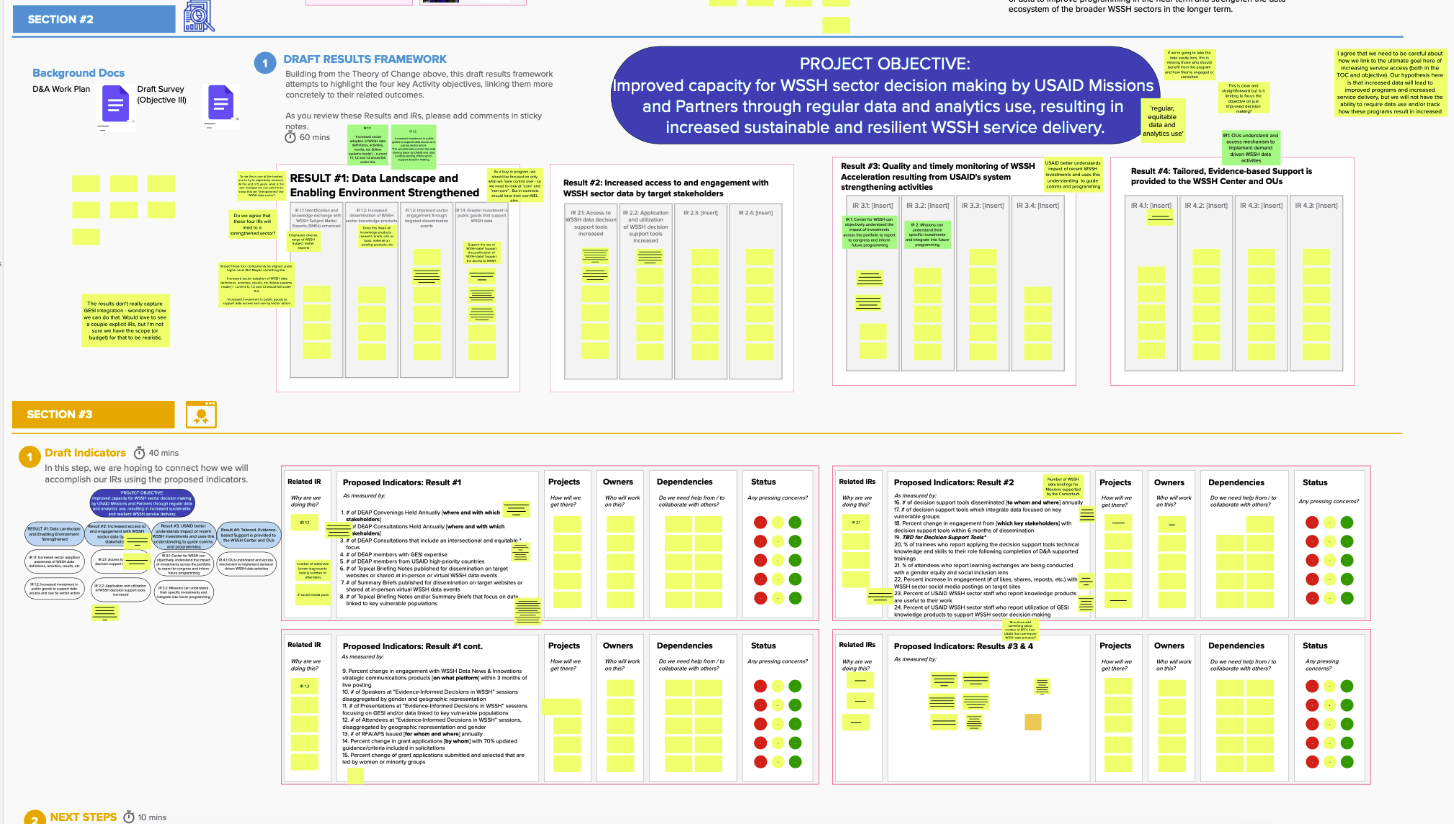
Facilitated a cross-partner strategy workshop to develop a shared theory of change and results framework for a multi-contractor water security initiative, supporting alignment across implementing partners and establishing initial indicators to guide program monitoring and learning.
Participants: ~10 technical staff representing multiple implementing partners
Format: Facilitated strategy workshop
Focus: Program strategy and results framework development
Context: Multi-partner water security initiative
Outputs: Theory of change, results framework, and preliminary performance indicators
engagement overview
Client ContextA water security initiative involved multiple implementing partners working together to address sanitation, hygiene, and water management challenges. With several contractors contributing to program implementation, the team needed a shared framework to clarify how their activities aligned and how progress would be measured. While each organization had clear technical roles, the broader program lacked a clear understanding of how to describe these activities and their collective contributions to long-term outcomes.
To address this gap, a facilitated small cross-partner workshop was convened to develop a theory of change, supporting results framework, and key performance indicators that could guide both implementation and program learning.
The ChallengePrograms implemented by multiple partners can face challenges aligning priorities and defining shared measures of success. Each organization often approaches implementation from different technical perspectives, making it difficult to build a unified framework that reflects collective goals. Without a common framework, partners risk working in parallel rather than toward a clearly articulated pathway of change.
This workshop was intended to create space for partners to step back from day-to-day implementation and jointly articulate how their work fit together.
Role & ContributionsI designed and facilitated the workshop, bringing together approximately ten participants representing several implementing partners. Because the group was small and technically diverse, the facilitation approach focused on structured discussion rather than presentation.
The session moved through several stages:
mapping core program objectives and a clear goal
identifying key outcomes across implementation areas
clarifying assumptions underlying the program strategy
developing a shared theory of change
drafting an accompanying results framework and preliminary indicators
Throughout the process, the emphasis was on discussion and joint problem-solving. The workshop emphasized structured dialogue, allowing partners to surface different perspectives while working toward shared understanding. Participants were encouraged to question assumptions and refine ideas collectively rather than simply react to a predefined framework.
ResultsBy the end of the workshop, the group had developed both a theory of change and a preliminary results framework that clarified how partner activities contributed to broader outcomes.
The process also helped establish:
a shared understanding of program priorities
clearer connections between technical activities and long-term goals
an initial set of indicators to guide monitoring and evaluation
Strategic ImpactIn multi-partner programs, alignment is often assumed rather than explicitly developed. Creating space for structured discussion allowed partners to clarify their roles, examine assumptions, strengthen collaboration, and agree on how progress would be understood across the program.
The workshop produced useful technical outputs, but its primary value was helping partners establish a common framework for thinking about their work going forward. This process helped establish a foundation for coordinated implementation and ongoing program learning.

“Christine’s ability to ground conversations in implementation realities, gender and social inclusion considerations, and clear key performance indicators helped the team not only align around a shared vision for the work but transform a group of contractors into a team with shared ownership of results. I would welcome the opportunity to work with Christine again on any initiative requiring thoughtful facilitation, strategic clarity, and the ability to move diverse stakeholders toward meaningful impact.”
— Jennifer Collins-foley, JD, chief of staffGet in Touch
Whether you have a question, an idea, or just want to say hello, feel free to reach out. We look forward to connecting within one to two business days.